Clinical background

Spine tumour surgery

Surgical management of spine tumours is one of the most complex fields — it requires precise diagnosis, multidisciplinary teamwork and specialised surgical experience. The clinical and research experience I gained in this area over the years is one of the foundations of my practice and informs every clinical decision I make.

Consultation and treatment I offer private consultations for patients with spine tumours: discussion of the diagnosis, treatment strategy and possible surgical pathways. Complex surgical management, however, always takes place within an institutional setting and with the involvement of a multidisciplinary team.
Ugrás Consultation Tumour types Surgical approaches Multidisciplinary care Research background Patient cases

What does a private consultation mean in a spine tumour case?

If you or a family member have been given a spine tumour diagnosis, the hardest part is often making sense of all the inputs at once: imaging reports, opinions, treatment options. The purpose of the consultation is to bring clarity to this — to help you understand what the reports actually say and what the realistic pathways are.

The consultation may cover

  • Review of existing imaging studies (MRI, CT, PET-CT)
  • Interpretation of the histological diagnosis
  • Overview of possible treatment strategies
  • Realistic weighing of surgical alternatives
  • Assessment of whether a multidisciplinary approach is needed
  • Help in organising the care pathway

Important: complex surgical intervention is not part of the private practice — institutional, team-based care is the only professionally appropriate framework. The aim of the consultation is to support your journey with the best clinical knowledge available, wherever the definitive treatment ultimately takes place.

The spectrum of spine tumours

Spine tumours form an extremely heterogeneous group — from benign bone lesions to rare primary malignancies, to common metastatic involvement. Each group requires a different treatment logic.

Primary spine tumours

Chordoma, giant cell tumour (GCT), osteosarcoma, chondrosarcoma, Ewing sarcoma and other rare primary bone tumours. These diseases are rare but require radical surgical treatment — often en bloc resection.

Sacral tumours

Sacral tumours — especially chordoma — require a specific, multi-stage surgical approach: combining the work of abdominal surgeons, plastic surgeons and urologists.

Spinal metastases

Management of metastatic disease: stabilization, nerve decompression, pain control. The treatment strategy is determined jointly by the underlying disease, expected survival and neurological status.

Tumour-like lesions

Benign bone lesions, such as osteoid osteoma, aneurysmal bone cyst or haemangioma. Differential diagnosis is critical; treatment is often targeted and minimally invasive.

Overview of surgical techniques

The surgical strategy depends on the tumour type, location, extent and the patient's overall condition. The spectrum ranges from targeted, minimally invasive procedures to multi-hour, multi-specialty complex resections.

En bloc resection

Removal of the tumour in a single piece with intact surgical margins — the international standard for the radical treatment of primary malignant spine tumours. This technique maximises the chance of local control and provides the best long-term oncological outcome. A technically and time-demanding operation that requires precise preoperative planning.
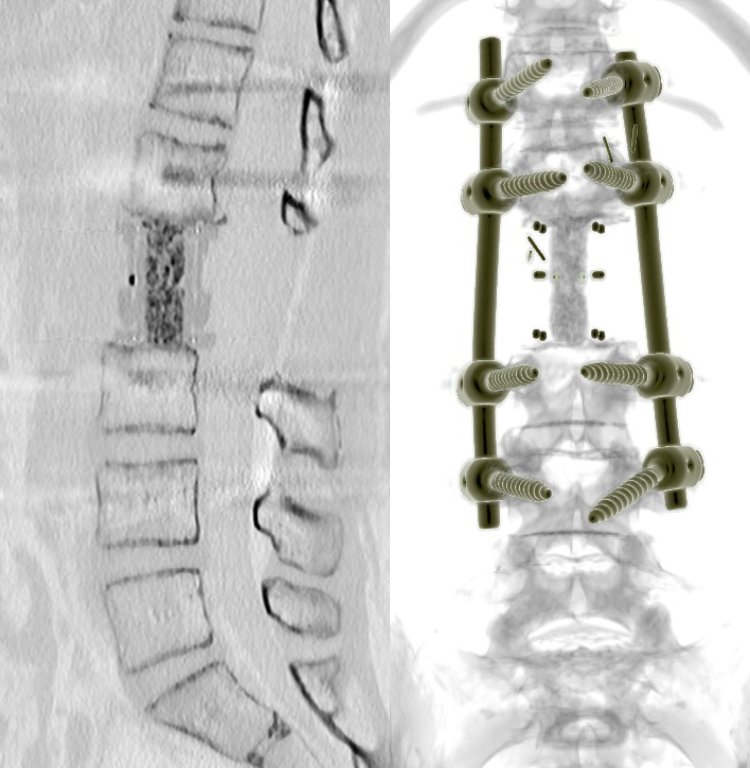
CT reconstruction after en bloc resection of a spine tumour
En bloc tumour resection and reconstruction: sagittal CT showing vertebral body replacement (left) and 3D reconstruction with posterior instrumentation (right)

Complex reconstructive surgery

Restoration of spinal stability after tumour removal, using a tumour prosthesis, titanium implants, cages and bone-graft substitute. For sacral and larger resections, the involvement of abdominal and plastic surgeons is also required for closure and reconstruction.

Minimally invasive procedures

For spinal metastases, where the goal is rapid pain control and preservation of neurological function: percutaneous stabilization, vertebroplasty (cement injection into the vertebra), and in selected cases radiofrequency ablation. These procedures involve a short hospital stay and faster recovery.

Urgent nerve decompression

In a patient with cancer, sudden new neurological symptoms — limb weakness, gait disturbance, pathological vertebral fracture — represent an urgent surgical indication. Rapid nerve decompression is critical for preserving function, often before oncological treatment begins.
Why teamwork is essential

The management of spine tumours is never the work of a single physician or a single specialty. A well-functioning surgical plan requires contributions from multiple disciplines:

This teamwork is one of the reasons why complex spine tumour surgery cannot be delivered in a private outpatient setting. An institutional multidisciplinary team ensures that every decision is made on the strongest available clinical evidence — and that is in the patient's interest.

Research and clinical experience

My clinical foundation in spine tumour surgery is rooted in a now-closed research chapter: during my PhD I established Hungary's first Primary Spine Tumour Registry, and as a member of an international research group I participated in several multicentre studies. This research background today serves as the evidence base for my clinical decisions.

PSTMS

Primary Spinal Tumor Mortality Score — a prognostic scoring system that predicts postoperative survival.

350+ cases

Institutional Primary Spine Tumour Registry — given the rarity of the disease, an internationally unique database.

AO Spine KFT

International research collaboration (AO Spine Knowledge Forum Tumors) advancing spine tumour care.

As complementary work, within the team at the National Center for Spinal Disorders, with the involvement of abdominal and plastic surgeons and using vacuum-assisted wound therapy techniques, we developed protocols that significantly improved the reduction of septic complications and postoperative outcomes.

The full publication list is available on the Google Scholar profile.

Typical clinical courses

The composite cases below illustrate slices of the spectrum of spine tumour surgery. Each was delivered within an institutional setting and with the involvement of a multidisciplinary team.

Osteoid osteoma

A young patient with persistent back pain

A 13-year-old boy with recurrent night-time back pain. RF ablation was not safe due to the proximity to the nerve — open surgical removal, with immediate symptom relief.

Read full case
Ewing sarcoma, chondrosarcoma

Same location, different treatment

Two young male patients, both with a mass lesion in the L4 vertebra. Same location, different histology — the treatment strategies were fundamentally different.

Read full case
Metastatic spine involvement

Urgent nerve decompression and oncology

A 48-year-old man with a history of renal cancer, presenting with acute pain and lower-limb weakness. Urgent surgery plus complex oncological treatment — 7+ years of survival with good quality of life.

Read full case
Sacral chordoma

Complex, multi-stage surgical treatment

A 65-year-old man presenting with bowel and bladder symptoms. En bloc resection with multi-specialty collaboration — stable oncological status with preserved quality of life.

Read full case
Dr. Zsolt Szövérfi
Written and medically reviewed by Dr. Zsolt Szövérfi PhD Spine Surgeon · Orthopaedic and Trauma Specialist · Full profile Last updated: April 2026

Book a private consultation

If you or a family member have been given a spine tumour diagnosis and need a clinical second opinion, an interpretation of the findings or a discussion of possible surgical pathways, I offer private consultations.

Book Appointment
More on the second-opinion consultation