Most spine problems do not require surgery. The aim of non-surgical treatment is to reduce pain, resolve inflammation, and strengthen the muscles that support the spine — step by step, achieving the greatest possible benefit with the smallest possible intervention.
Non-surgical treatment is the first and most important option for the vast majority of spine pain. The goal is not simply to silence pain, but to address its source directly and to restore the muscular system that moves the spine — so that symptoms resolve in a lasting way.
Non-surgical therapy is particularly effective in the following conditions:
It is also valuable when surgery is not feasible (e.g. significant comorbidity, severe osteoporosis), or when the patient prefers to avoid the surgical route — within what is medically reasonable.
Treatment methods are always tailored to the nature and source of the symptoms — typically not a single technique, but a combination of these, applied sequentially or in parallel. A precise plan requires a spine surgical consultation and a recent MRI.
Targeted delivery of local anaesthetic and anti-inflammatory steroid next to the affected nerve root, under CT or fluoroscopic guidance. Particularly effective for radiating pain caused by disc herniation or foraminal stenosis.
DetailsTargeted treatment of pain originating from the small joints between the vertebrae (facet joints). Typical indication: chronic, mechanical-type lower back pain that worsens with movement, in older patients.
DetailsTargeted injection therapy for sacroiliac joint dysfunction. Often missed diagnostically, even though SI joint pathology accounts for a substantial proportion of low back pain.
DetailsAn anti-inflammatory and pain-relieving infusion course, with a composition tailored to the source of pain. Delivered on an outpatient basis. Faster onset than oral medication.
DetailsOne-on-one, personalised movement therapy — far more effective than group programmes: the physiotherapist designs an individual treatment plan with muscle-relaxation and pain-relief exercises, and strengthens the deep stabilising muscles of the spine. Required in nearly every case for lasting results.
DetailsNon-steroidal anti-inflammatories, muscle relaxants, agents acting on neuropathic pain — selected according to the character of the pain. Rarely sufficient on its own, but an important complement to the other modalities.
One of the most effective tools in non-surgical spine care is the CT-guided targeted block injection. Imaging guidance ensures that a minimal amount of medication is delivered exactly where the source of pain is, without unnecessarily burdening the rest of the body.
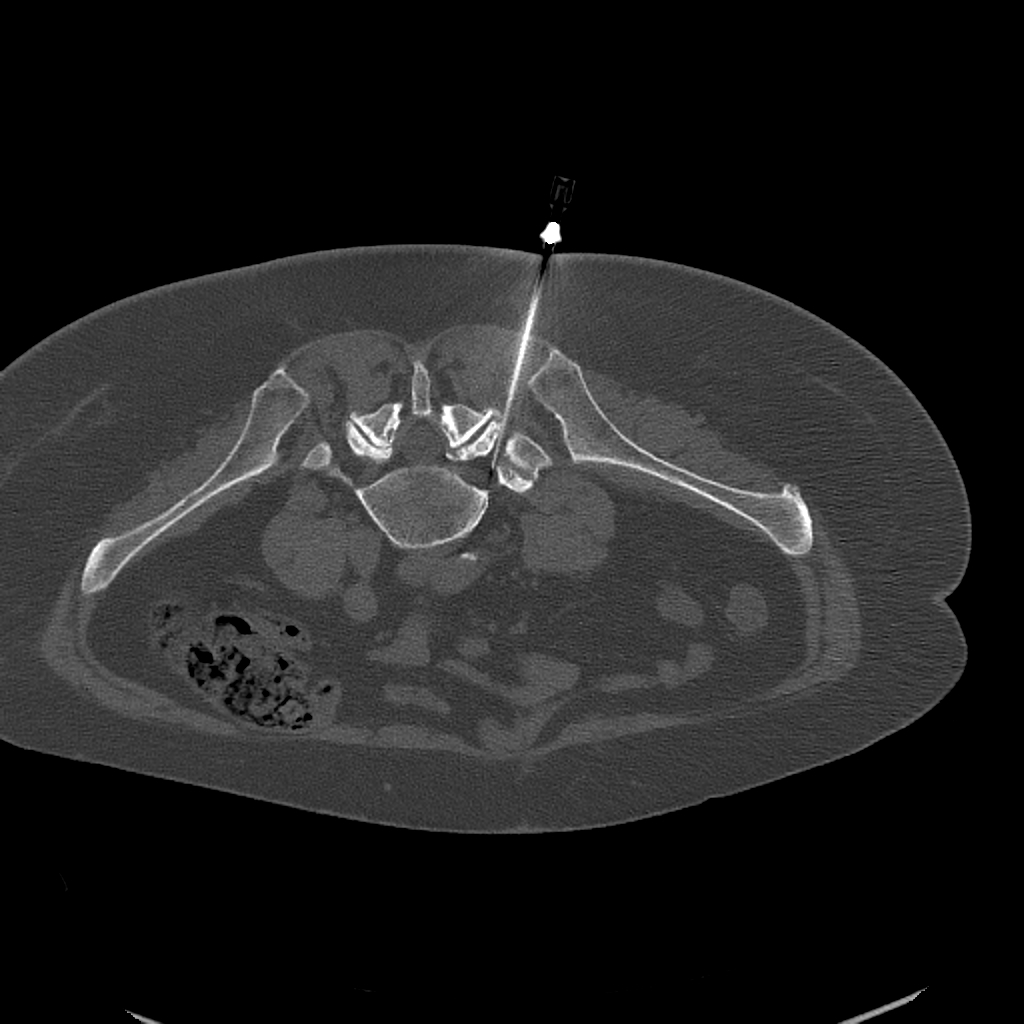
If the nerve emerging between the vertebrae is the source of pain — for example due to compression from a disc herniation or spinal stenosis — a targeted nerve root block is the appropriate intervention. During the procedure, a minimal amount of local anaesthetic and anti-inflammatory steroid is delivered next to the affected nerve root.
Needle placement is verified using CT or fluoroscopy, so that the treatment reaches only the inflamed nerve. The local anaesthetic may cause temporary numbness or weakness — this is a normal phenomenon that typically resolves within a few hours.
Increased loading of the small joints between the vertebrae (facet joints) accelerates cartilage wear (arthrosis), which can produce mechanical-type low back pain that worsens with movement. In such cases, a small amount of local anaesthetic and anti-inflammatory steroid is delivered into the painful joint, again under CT or fluoroscopic guidance.
The sacroiliac (SI) joint — the connection between the sacrum and the pelvis — is one of the most common, yet most frequently misdiagnosed, sources of low back pain. The pain is typically one-sided, felt in the upper buttock or around the greater trochanter of the femur, and is often aggravated by sitting, prolonged standing or asymmetric loading.
Typical contexts for its development: post-partum state, one-sided sport or occupational loading, leg-length discrepancy, prior injury, or altered biomechanics following spine surgery.
Diagnosis is clarified through a combination of targeted physical examination and imaging — in uncertain cases, the diagnostic SI block itself helps confirm the origin: if the pain disappears after the injection, the source is identified.
Treatment follows the same targeted block logic as elsewhere in the spine: under imaging guidance, local anaesthetic and anti-inflammatory steroid are delivered into the joint. This is often complemented by targeted physiotherapy that stabilises the muscles of the pelvic girdle.
An infusion course is an alternative to oral anti-inflammatory and pain-relief medication. Its advantages: faster, stronger effect, predictable dosing, and less burden on the gastrointestinal tract. Typical indications: an acute, severe episode of low back pain, or persistent symptoms that respond inadequately to oral medication.
The course is individualised — composition is determined by the nature of the pain, the patient's general health and any concomitant conditions. A combination of anti-inflammatory, muscle-relaxant and analgesic components is typical.
Infusion therapy is delivered on an outpatient basis at Budai Egészségközpont. Each session takes a few hours, over several consecutive days. The duration and frequency of the course are adjusted to the severity of the symptoms and the therapeutic response — typically as a multi-day cycle.
The vast majority of spine complaints involve a muscular imbalance — either as the primary cause, or as a contributing factor alongside disc, nerve root or joint pathology. For this reason, targeted physiotherapy is an essential element of nearly every non-surgical treatment plan: it strengthens the deep stabilising muscles of the spine and restores the natural balance of the musculoskeletal system.
Block injections, infusions or medication eliminate pain and inflammation — physiotherapy ensures the improvement lasts. A well-designed 2–3 month programme not only relieves the current symptoms but also helps prevent recurrence.
I work together with the physiotherapy team at Budai Egészségközpont. Part of the treatment plan is that, following the block or infusion course, the patient receives a personalised exercise programme whose key elements they must also perform at home.
Every patient journey is individual — but the main milestones follow a similar pattern. The steps below show what to expect from the first appointment to full recovery.
Spine surgical outpatient appointment: detailed history, physical and neurological examination, review of any existing imaging. The aim is to identify the source of pain — at this stage, the likely diagnosis often already emerges.
Further imaging if needed: MRI, CT, X-ray — depending on what is required for an accurate diagnosis. MRI is the primary tool for evaluating soft tissues (disc, nerves); CT and X-ray assess the bony structure.
Based on the new findings, we discuss the precise diagnosis, the treatment alternatives and the expected course. We decide together on the main elements of the personalised treatment plan.
Treatment is a combination of one or more modalities — medication, CT-guided block, outpatient infusion course, physiotherapy or a combination of these. The composition is case-dependent and can be refined as treatment progresses, in line with the response.
Evaluation of treatment effectiveness — typically 2–4 weeks after the course is completed. If needed: repetition, adjustment, or — if the non-surgical pathway has not produced sufficient improvement — a discussion of the surgical options.
A 40-year-old patient working in an office presented with disc herniation causing pain radiating into the left leg. After medication and a targeted CT-guided injection, followed by physiotherapy, the patient gradually returned to normal life — without surgery.
Read full caseNon-surgical treatment can be highly effective — but it is worth knowing in advance what it does and does not deliver. The table below helps anchor expectations in reality.
Non-surgical treatment is often sufficient — but in some situations, the surgical solution is the fastest and most effective route:
If your situation falls into one of these categories, you can also request a separate second-opinion consultation — an independent professional perspective can help make the decision more confident.
After the skin is disinfected, you will feel a single needle prick; during the procedure itself there is only mild pressure. As the needle approaches the nerve, you may feel a brief radiating sensation in the leg. Most patients do not describe significant pain. Immediately after the procedure, the local anaesthetic may cause temporary numbness or weakness in the treated area — this resolves completely within a few hours.
The local anaesthetic takes effect within hours; the anti-inflammatory steroid develops its effect over 2–7 days and can last for weeks to months. If the response is partial or short-lived, the treatment can be repeated.
In most cases a single block produces significant improvement. If the response is partial, the treatment can be repeated after 2–3 weeks. Long-term repeated blocks over many months are not recommended — if symptoms remain that persistent, the treatment strategy needs to be reconsidered.
A 10–30 minute observation period is required after the procedure. If you have no symptoms, you can go home unaccompanied. Driving on the day of the treatment is not recommended due to the temporary numbness or weakness.
A recent MRI (no older than 3 months) is essential. Targeted treatment cannot be planned without diagnostic imaging. During the consultation I review the findings and we decide whether further imaging is needed.
All medications taken during the treatment are reviewed at the consultation. Anti-inflammatories and standard painkillers can usually be continued. With anticoagulants (blood thinners), modification or a pause may be needed in the days before the block — this is always discussed in advance.
After most non-surgical procedures, return to office work is possible the next day. For physical work, the timing is agreed individually — typically a few days of rest. For sport, 1–2 weeks is recommended.
At a follow-up consultation we discuss the next steps. These may include: trying a different modality (e.g. an infusion course instead of a block), repeating the treatment with different parameters, or — if the non-surgical pathway has been exhausted — considering the surgical alternatives. The treatment journey is never definitively closed; there is always a logical next step.
An accurate diagnosis and a personalised treatment plan are the first steps towards recovery.
Book Appointment