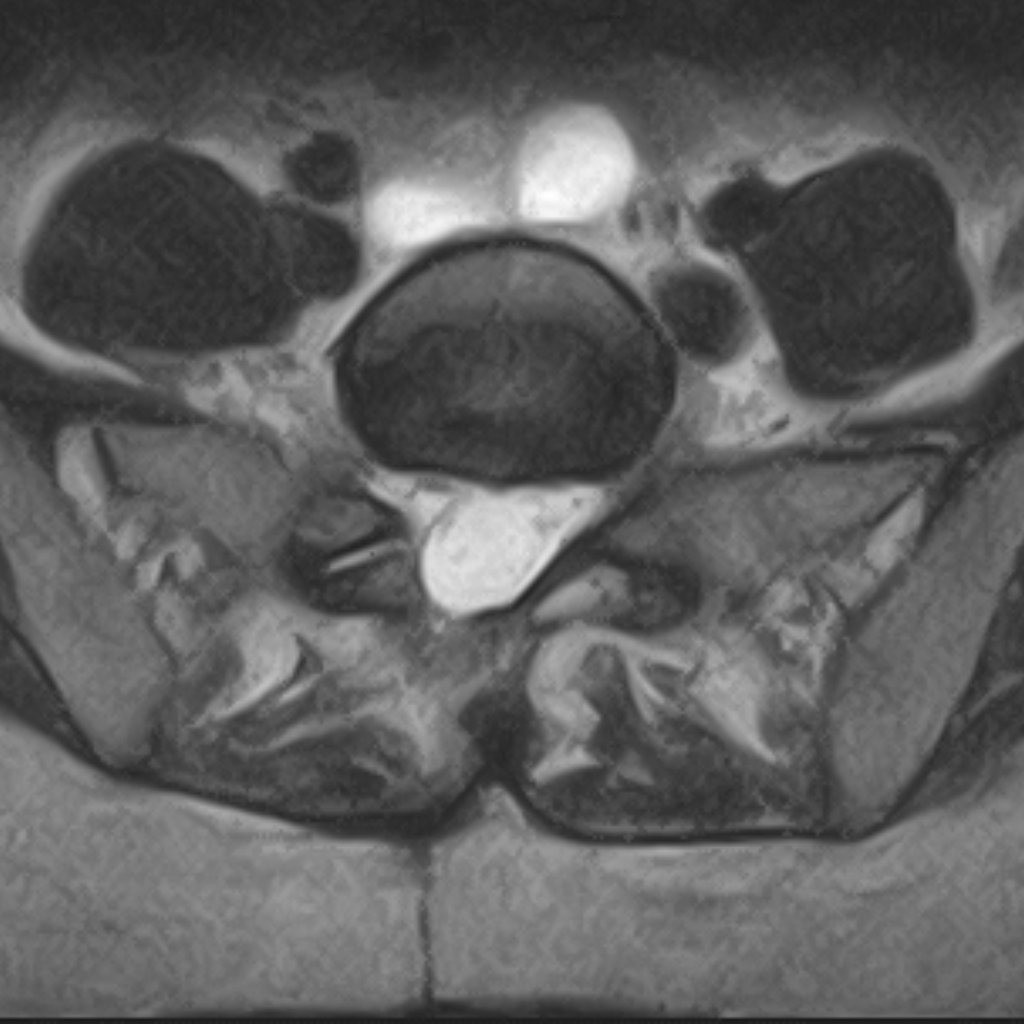
Disc herniation is the most common degenerative spine condition. Around 70% of cases resolve with non-surgical treatment — surgery is only required when symptoms persist or there is established nerve damage.
The intervertebral discs between the vertebrae act as flexible cushions that absorb load and allow movement. The fibrous outer wall of the disc (annulus fibrosus) can weaken over time, and a bulge can form on it, putting pressure on the nerves running directly alongside.
Another presentation is the sequestrated disc herniation: a tear forms in the fibrous ring, through which the gel-like material from inside the disc (nucleus pulposus) escapes outside the disc. In this case, in addition to the mechanical pressure on the nerve, the chemical properties of the displaced material also irritate the nerves. Pressure and chemical irritation together create inflammation in the neural elements, which sustains the pain syndrome.
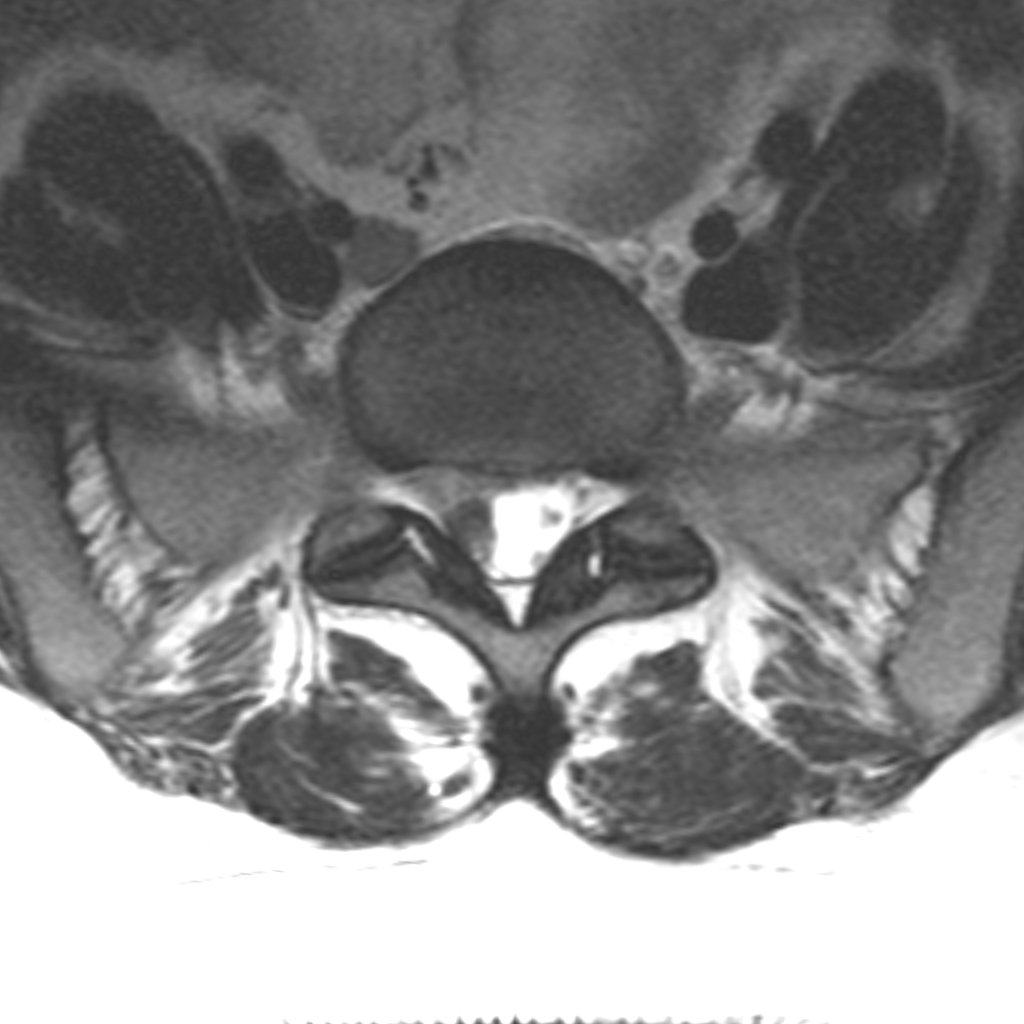
If disc herniation is suspected, an MRI examination is needed for accurate diagnosis. If the clinical picture does not suggest urgent surgical indication, the first step is almost always non-surgical treatment. A significant proportion of disc herniations resolve durably within a few weeks to months with targeted injection therapy, anti-inflammatory medication and physiotherapy — without surgical intervention.
A significant proportion of patients with disc herniation become lastingly symptom-free without surgery. A detailed overview of non-surgical treatment is available on the dedicated page.
More on non-surgical treatmentDisc herniation in the lower back typically causes pain radiating into the leg (sciatica), often with numbness and muscle weakness. The pattern of symptoms helps to identify the responsible segment — but accurate diagnosis requires MRI.
The surgery exposes the spine through a small skin incision (2–3 cm), and a minimal bony window is opened in the gap between two vertebrae. Through this corridor, the herniated disc fragment compressing the nerve is removed and the neural elements are decompressed.
Among the techniques currently in use — conventional exposure, microscopic technique (microdiscectomy), endoscopic discectomy — experience suggests there is no clinically significant difference in long-term outcomes. Wherever possible, I always favour the least invasive solution.
Disc herniation in the cervical spine can cause nerve root or spinal cord compression. Symptoms typically include pain radiating into the arm, numbness, clumsiness in fine motor movements, and in more severe cases gait disturbance or hand weakness.
Through a 3–4 cm skin incision in the front of the neck, the spine is exposed, the disc and the herniation that has extruded into the spinal canal are removed, and the neural elements are decompressed.
A cage is placed in the position of the disc, secured with screws or a plate. The cage contains bone-graft substitute, which allows the neighbouring vertebrae to fuse over time. The procedure can be performed on up to four adjacent segments. In some cases, a mobile disc prosthesis can also be implanted, where preserving the motion of adjacent segments is advantageous.
ACDF relieves symptoms with a high success rate. Recovery time is typically about one month.
The same diagnosis — three different paths. The composite cases below show how disc herniation treatment is always an individual decision: the non-surgical success, the planned surgery and the urgent intervention are all real-world scenarios.
A 40-year-old patient working in an office. After a CT-guided injection and physiotherapy, the patient became lastingly symptom-free — without surgery.
Read full caseA 45-year-old active man. Non-surgical treatment brought only temporary improvement — after surgery, immediate symptomatic improvement and full recovery.
Read full caseA 42-year-old dentist with cervical disc herniation and developed paralysis. ACDF surgery within 24 hours, full functional recovery within 3 months.
Read full caseWhether you have suspected disc herniation or a confirmed diagnosis and want to learn about the treatment options, the first step is a spine surgical consultation.
Book Appointment